Slow down to 40km/h when bus lights flash and help keep kids safe
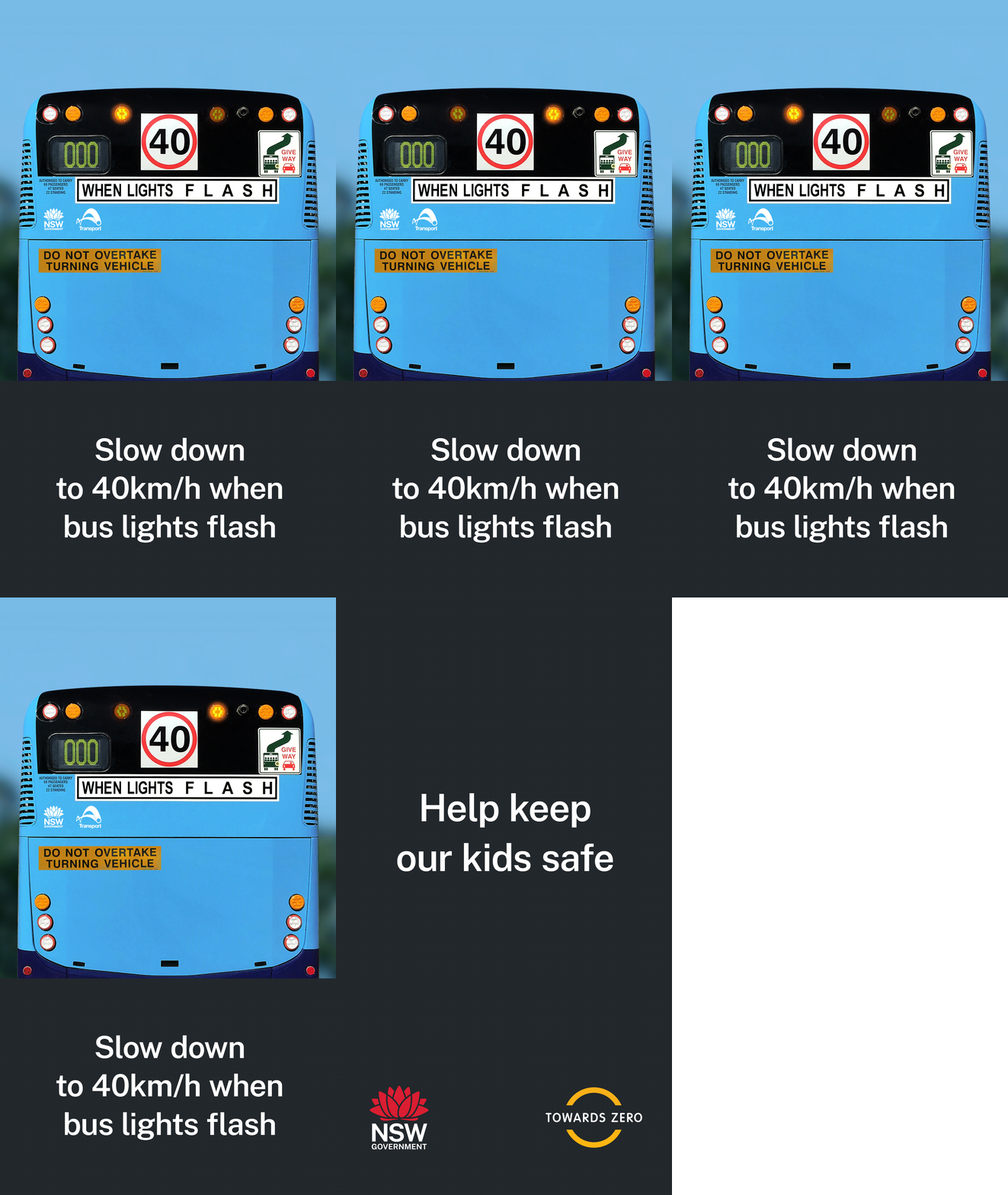
The ‘Bus flashing lights’ campaign runs at the start of each school term throughout the year, to remind motorists to slow down to 40km/h when bus lights flash - unless a lower speed limit applies. Flashing lights indicate that the bus is picking up or setting down school children who may be on or near the road.
The initiative also promotes important messages for parents and families around getting their child to and from the bus stop safely. This is part of the ‘school zones’ campaign, which reminds motorists to drive under the school zone speed limit when school zones are active.
This quarterly campaign uses the following paid media channels:
- Radio (metro and regional)
- Social media posts (via NSW Road Safety Facebook)
- Variable Message Screens (VMS)
- Resources for road safety partners and stakeholders to use and share, including videos and social media assets.
For more information, visit: www.transport.nsw.gov.au/roadsafety/road-users/drivers/be-bus-aware#Bus_flashing_lights
Motorists
- Lights flash on buses to warn motorists that buses are picking up and dropping off children.
- You must slow down to 40km/h when overtaking or passing a bus displaying flashing lights, unless a lower speed limit applies.
- You can help keep children safe by:
- sticking to the speed limit and following the road rules in school zones
- slowing down to 40km/h when bus lights are flashing, unless a lower speed limit applies
- looking out for children crossing the road near bus stops, in school zones or along bus routes
- giving way to buses when they merge back into traffic.
- For more information visit www.transport.nsw.gov.au/roadsafety/road-users/drivers/be-bus-aware#Bus_flashing_lights
Parents and carers
- You're responsible for getting your child to and from the bus stop safely.
- When travelling by bus, your child is most at risk in the minutes after they get off the bus.
- Always supervise your child and hold their hand when walking to and from the bus stop and when crossing the road, until they're at least 10 years old.
- Meet your child at the designated stop time on the same side of the road as the bus stop – never call your child across the road.
- Remind your children to always wait until the bus has gone before choosing a safe place to cross the road.
- Talk to your children about Stop! Look! Listen! Think! every time they cross the road:
- Stop one step back from the kerb
- Look continuously both ways
- Listen for the sounds of approaching traffic
- Think whether it's safe to cross and keep checking until safely across.
- Encourage your child to take a seat quickly when they get on the bus and to buckle up if the bus has seatbelts.
- Talk to and remind your child to get off the bus at their designated stop.
- Safety Town - our road safety website for primary school students, teachers and families - contains information for families around driving safely around buses and also around getting children to and from the bus stop safely.
- If you've recently moved, or your child is starting or changing schools, make sure you plan your trip in advance. These fact sheets provide information on getting your child to and from school safely.
- Does your child use a rural bus stop that doesn’t have signage or other infrastructure? Think about whether it’s located in a safe spot that allows buses to stop away from the road, with good lines of sight in both directions, and includes a safe space for you to park your vehicle and wait. You can talk to your local bus operator or learn more here.
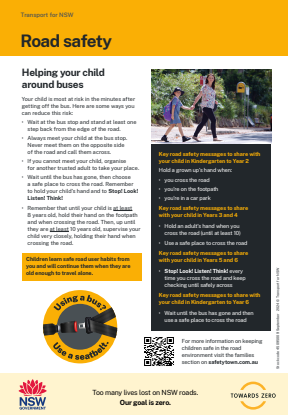
- More information is available in this brochure: Bus safety for school students: How families can help.
- For more information visit www.transport.nsw.gov.au/roadsafety/road-users/drivers/be-bus-aware#Bus_flashing_lights
Log into the Creative Assets Library before opening the CAL links. Instructions for using the Creative Assets Library are at the bottom of this page.
Graphics (static)
 |
 |
.png)
|
|
Slow down to 40 when bus lights flash
Download image:
|
Bus flashing lights
Download image:
|
Be Bus Aware bus flashing lights
Download image:
|
Animations
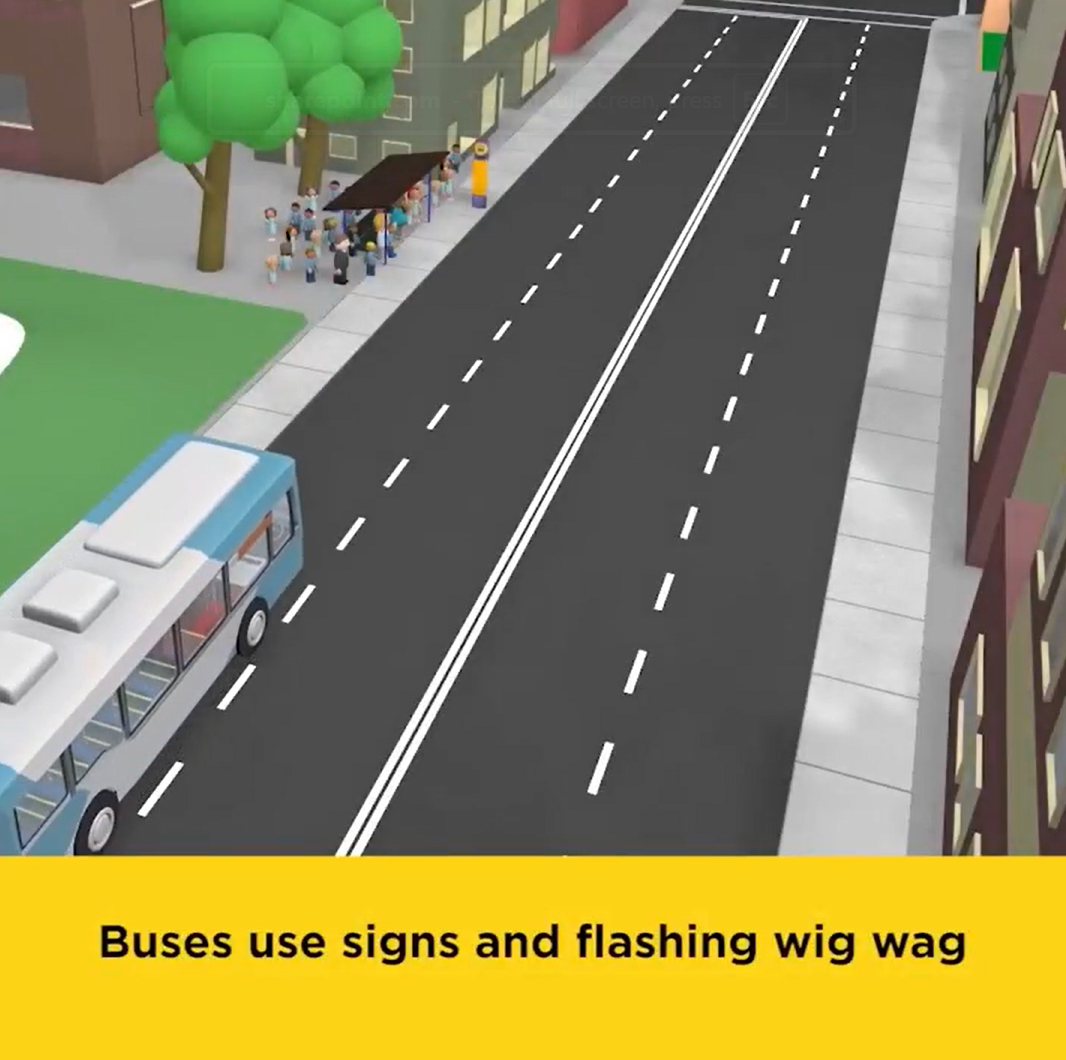
Open CAL download links to view animations
 |
|

|
|
Animated GIF
Download image:
|
Bus flashing lights
Download image:
|
Drivers slow down near informal bus stops (regional)
Download image:
|

|

|
|
|
Wait for the bus to leave then find a safe place to cross (regional)
Download image:
|
Adults get your child to and from the bus safely (regional)
Download image:
|
|
Photos
There are a variety of photos available via the Creative Assets Library
|
|
|
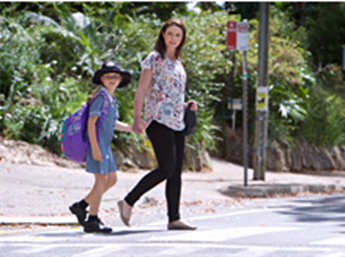
An adult holding a child's hand while crossing the road. They are looking left and right as they cross.
Download on CAL: 118823
|
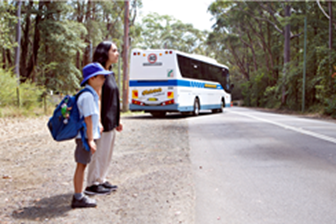
An adult holding a child's hand while they wait for the bus to leave before using a safe place to cross the road.
Download on CAL: 111807
|
Videos
This messaging can be applicable to various graphic and video assets provided above.
Option 1: Lights flash on the back of buses to warn motorists they're picking up or dropping off kids. Slow down to 40km/h and look out for children crossing the road.
Option 2: Remind your child to always wait until the bus has gone before choosing a safe place to cross the road.
Learn how to use the Creative Assets Library (CAL)
Expand allCollapse all
- Visit our online catalogue.
- Enter Product code in the search field.
- Locate the product and click ‘Continue’.
- Enter the quantity (some items have an order amount limit).
- Click ‘Add to cart’.
- If you've finished ordering, click ‘Checkout’ or to continue ordering, click ‘Continue Shopping’.
- Complete all the details under Billing Address and Shipping Address and then click ‘Next’.
- You'll now see the items you ordered under ‘Ordered items’.
Note:
- Deliveries can't be sent to a PO Box or outside of NSW.
- Orders must be completed on a desktop (not mobile).
- Some links may refer to the Creative Asset Library (CAL). Separate instructions to use CAL are available at the bottom of this page.
 |
 |

|
|
Bus flashing lights - Help keep our kids safe - A3 Poster
|
Be Bus Aware - Slow down to 40 when lights flash - A3 Poster
|
Bus safety for school students
|
|
|
|
|
Fact sheets - A4
List of factsheets covering various topics around keeping children safe in the road environment.
|
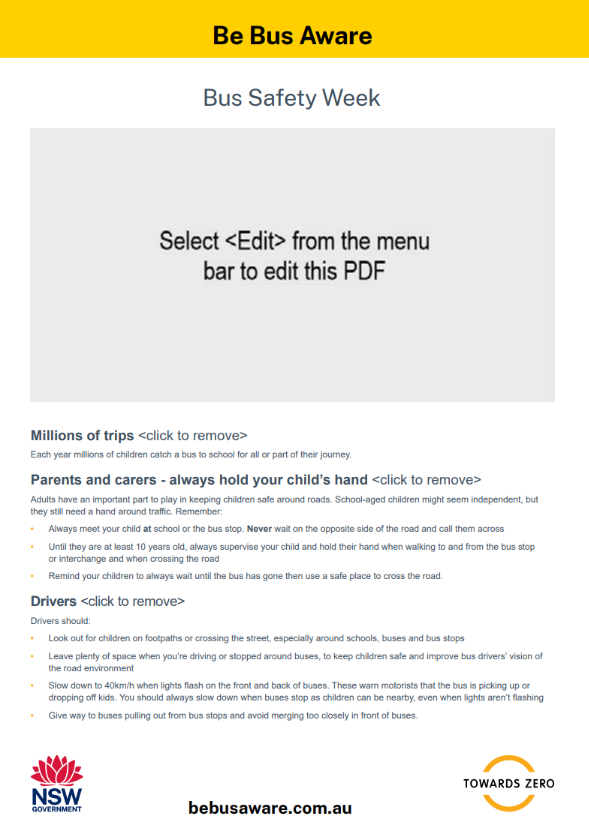
Bus Safety Week editable template - A4
|
|
Motorists 15 second script: Lights flash on the back of buses to warn motorists that they’re picking up or dropping off school children. Slow down to 40 kilometres per hour when the lights on buses are flashing. Keep our children safe. They’re counting on you.
Download on CAL 116806
Parents and carers 15 second script: If your child catches the bus to or from school, remind them to always wait until the bus has gone before choosing a safe place to cross the road. Keep our children safe. They’re counting on you.
Download on CAL 116807
Slow down to 40km/h when bus lights flash
Help keep kids safe
Flashing lights on school buses warn drivers that children are being picked up and dropped off and so may be on or near the road. When you see a bus displaying flashing lights, you must slow down to 40km/h when overtaking or passing it, unless a lower speed limit applies.
Motorists, you can help keep children safe by:
- slowing to 40km/h when bus lights are flashing
- looking out for children who may run out from in front of, or behind, a bus.
Parents and carers play an important role too. When travelling by bus, your child is most at risk in the minutes after they get off the bus. Together with your child, choose the safest place to cross the road and talk about:
- STOP! one step back from the kerb
- LOOK! continuously both ways
- LISTEN! for the sounds of approaching traffic
- THINK! whether it is safe to cross.
Keep checking as you cross the road.
Meet your child at the bus stop or interchange after school. Never wait on the opposite side of the road and call them across
For more information, read the Bus safety for school students brochure or visit www.transport.nsw.gov.au/roadsafety/road-users/drivers/be-bus-aware#Bus_flashing_lights
Use our quiz for your community engagements: https://quiz.towardszero.nsw.gov.au/bus-safety
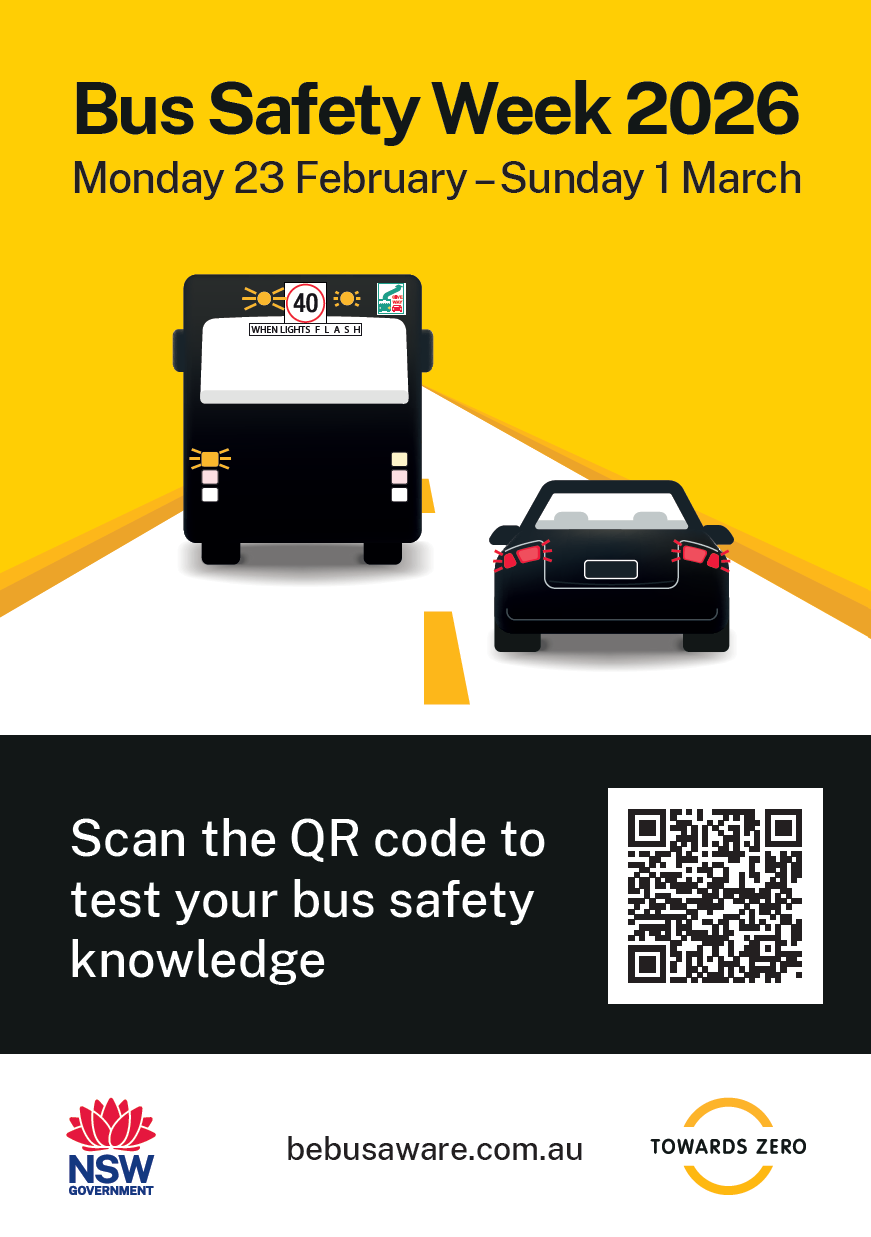
Download quiz promo poster (Activations) - Digital version
Download quiz promo poster (Activations) - Print-ready version
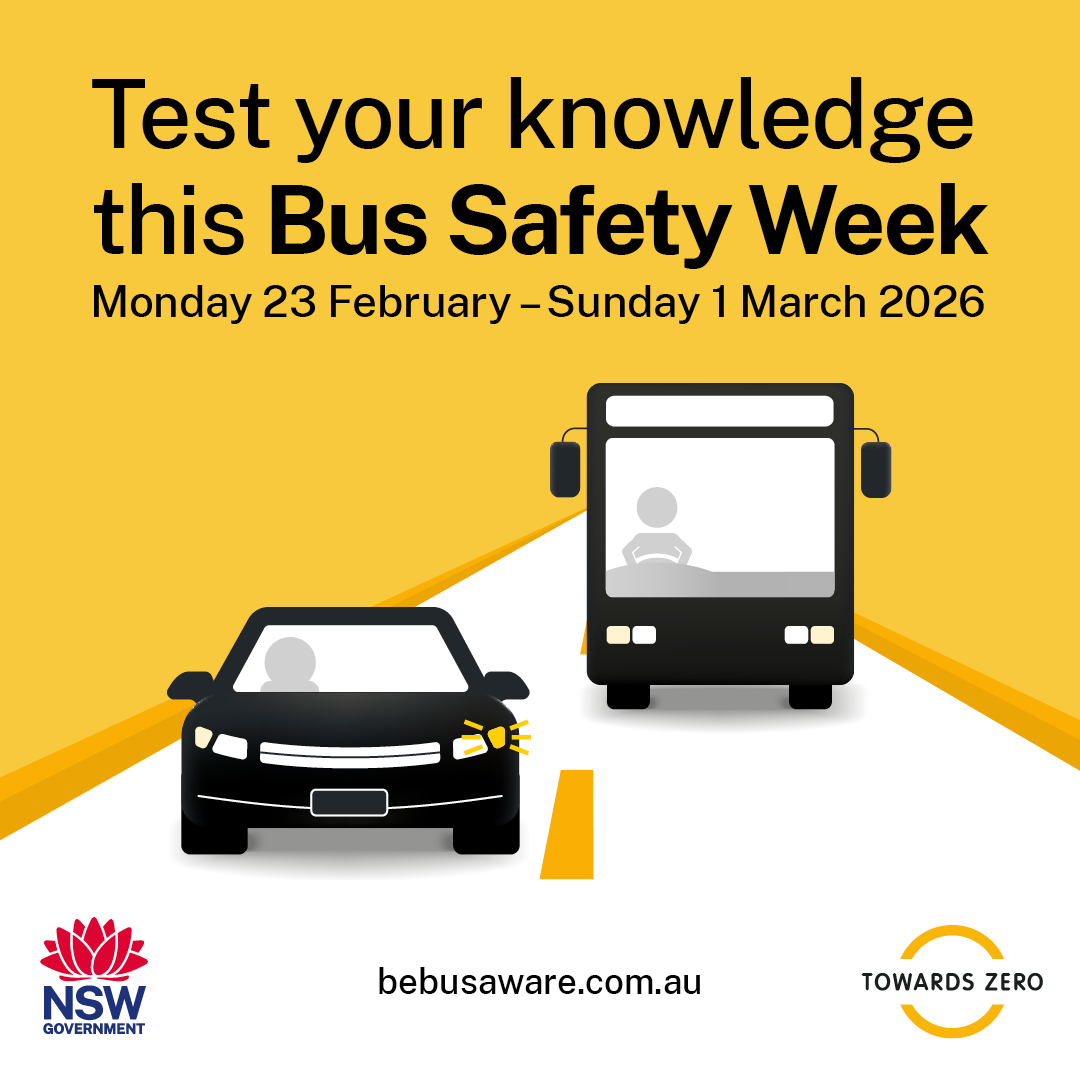
Download quiz promo tile (Digital)
Expand allCollapse all
You can incorporate some of these questions into your social media posts or in-person engagements.
- Lights flash on the back of buses to:
- A. Warn drivers the speed limit is 40km/h when passing the bus (unless a lower speed limit applies)
- B. To warn drivers the bus is picking up or setting down children
- C. Both a and b
Correct answer: C
- If a bus has its right indicator on and is pulling out of a kerb, you must:
- A. Give way to the bus
- B. Increase your speed to get past the bus before it has pulled out
Correct answer: A
- It is illegal to cross the road within 20 metres of a pedestrian crossing. True or False?
Correct answer: A
Feedback: It is illegal to cross the road within 20 metres of a pedestrian crossing. When you get off a bus, wait for the bus to leave then use a safe place to cross the road, such as a ‘zebra’ pedestrian crossing or traffic lights. If these aren’t available, find a safe place to cross the road which has a good line of sight in both directions. Look left and right continuously as you cross.
- It is recommended that parents hold their child’s hand when crossing the road until they are at least:
- A. 5 years of age
- B. 7 years of age
- C. 10 years of age
Correct answer: C
Feedback: Talk to your children about using Stop! Look! Listen! Think! every time they cross the road.
• Stop one step back from the kerb.
• Look continuously both ways.
• Listen for the sounds of approaching traffic.
• Think whether it's safe to cross and keep checking until you're safely across.
- Unless a lower speed limit applies, when lights flash on the back of a bus you should stay below:
- A. 40km/h
- B. 50km/h
- C. 60km/h
Correct answer: A
Feedback: Lights flash on the back of a bus to warn drivers the bus is picking up or setting down children, and that the speed limit is 40km/h when passing the bus. Slow down and look out for children who may be on or near the road.
- Other vehicles may drive in bus lanes for a maximum of 100 metres to enter or leave the road at a driveway or intersection, to avoid an obstacle or to pass another vehicle that is turning right. True or False?
Correct answer: A
Feedback: Bus lanes are for buses but can also be used by:
• taxis
• hire cars
• emergency vehicles
• bicycles and motorcycles.
However other vehicles may drive in bus lanes for a maximum of 100 metres to enter or leave the road at a driveway or intersection, to avoid an obstacle, to pass another vehicle that is turning right, or if there’s a sign saying they can. Only buses are allowed to drive in Bus Only Lanes unless it is necessary for a driver to avoid an obstruction.
- If choosing a location for an informal bus stop, which of these factors is NOT a key safety issue that you need to consider?
- A. Sight line for vehicles approaching from behind the bus
- B. Sight line for vehicles approaching from in front of the bus
- C. Road shoulder width for a bus to stop clear of traffic
- D. Waiting area for school children
- E. Pedestrian route to and from the bus stop
- F. Whether the bus has infrastructure (such as a road sign or bus shelter) or not.
Correct answer: F
Feedback: Informal bus stops are not sign posted or developed and are usually found in rural areas. They may be at the front of a property or on the side of the road.
Parents and carers play an important role in ensuring the safety of students around informal bus stops. If your child needs to use an informal bus stop, think about whether it’s located in a safe spot that allows buses to stop away from the road, with good lines of sight in both directions, and includes a safe place for you to park your vehicle and wait. You can talk to your local bus operator or find more information at www.BeBusAware.com.au
- When travelling by bus, your child is most at risk in the minutes after they get off the bus. True or False?
Correct answer: A
Feedback: When travelling by bus, your child is most at risk in the minutes after they get off the bus. Meet your child AT school or the bus stop. NEVER wait on the opposite side of the road and call them across. If you cannot meet your child, organise for a trusted adult to take your place.
Talk with your child about what to do:
• if you are delayed and cannot meet them as usual
• if they catch the wrong bus
• if they get off the bus at the wrong bus stop.
Together, choose the safest place to cross the road and talk about STOP! LOOK! LISTEN! THINK!:
• STOP! one step back from the kerb
• LOOK! continuously both ways
• LISTEN! for the sounds of approaching traffic
• THINK! whether it is safe to cross.
Keep checking as you cross the road.
For more information, please visit www.BeBusAware.com.au
- When getting off the bus, should you:
- A. Quickly dart in front of the bus so you can cross the road before it departs
- B. Always wait until the bus has gone and then find a safe place to cross
Correct answer: B
Feedback: Always wait until the bus has gone, then use a safe place to cross. This is to ensure you are visible to the bus driver and traffic coming in either direction. For more information, please visit www.BeBusAware.com.au
- In NSW approximately how many passenger trips are taken by bus per year?
- A. 145 million
- B. 245 million
- C. 345 million
Correct answer: C
Feedback: Almost 4000 buses operate in the Sydney area, while another 1000 buses service the Newcastle, Wollongong and Blue Mountains areas. There are also more than 3000 bus services operating in rural and regional NSW. Buses provide the greatest access to public transport of any mode of transport.
- Are passengers legally required to wear a seatbelt on a bus in NSW if one is provided?
- A. No, it's optional
- B. Only on long-distance trips
- C. Yes, it's a legal requirement
- D. Only if the driver reminds them.
Correct answer: C
Feedback: If a bus has seatbelts, passengers are legally required to wear them.
Wearing a seatbelt doubles the chance of surviving a crash and reduces the risk of injury. In a crash, a seatbelt:
• helps the body slow down at the same rate as the bus
• spreads the force of the impact over the stronger parts of the body (pelvis and chest areas)
• reduces the risk of passengers colliding with each other or the inside of the vehicle
• reduces the risk of the driver or passengers being thrown from the vehicle
- Bus passengers can be fined if they fail to wear a seatbelt on a bus when one is available. True or False?
Correct answer: A
Feedback: Passengers aged 16 years or older can be fined for not wearing a seatbelt on a bus, if one is fitted.
In addition, students who fail to wear a seatbelt properly adjusted and fastened can be subject to a temporary or permanent travel suspension, in accordance with the Transport for NSW Student Code of Conduct.
Bus operators are also generally required to take reasonable steps to ensure that bus passengers are aware that they're required to wear a seatbelt, if fitted, and that they can be fined for not doing so. For more information visit www.transport.nsw.gov.au/roadsafety/road-users/drivers/be-bus-aware#Seatbelts_on_buses
- What does the "Do Not Overtake Turning Vehicle" sign mean?
- A. You can overtake the vehicle if there is enough space
- B. You must not overtake the vehicle while it is turning
- C. You can only overtake on the left side
- D. The vehicle is allowed to speed up while turning
Correct answer: B
Feedback: When a vehicle displays a ‘Do not overtake turning vehicle’ sign, you must not:
• overtake on the left when the vehicle is turning left
• overtake on the right when the vehicle is turning right, unless it’s safe to do so.
When a vehicle displays a ‘Do not overtake turning vehicle’ sign, you must not overtake on the left, unless it’s safe to do so and:
• you’re driving on a multi-lane road
• the vehicle is stationary
• the vehicle is turning right or making a U-turn.
For more information visit www.nsw.gov.au/driving-boating-and-transport/roads-safety-and-rules/sharing-road-overtaking-and-merging/overtaking-safely
- When is a long vehicle legally allowed to turn left from the middle or left lane in NSW?
- A. Only when there are no other vehicles nearby
- B. If it has a "Do Not Overtake Turning Vehicle" sign displayed
- C. If the driver uses the horn
- D. Only at night or in rural areas
Correct answer: B
Feedback: When a vehicle displays a ‘Do not overtake turning vehicle’ sign, you must not:
• overtake on the left when the vehicle is turning left
• overtake on the right when the vehicle is turning right, unless it’s safe to do so.
When a vehicle displays a ‘Do not overtake turning vehicle’ sign, you must not overtake on the left, unless it’s safe to do so and:
• you’re driving on a multi-lane road
• the vehicle is stationary
• the vehicle is turning right or making a U-turn.
For more information visit www.nsw.gov.au/driving-boating-and-transport/roads-safety-and-rules/sharing-road-overtaking-and-merging/overtaking-safely
If you already have an account, log in at creativeassets.transport.nsw.gov.au and search for the relevant CAL ID.
To create an account:
-
Visit creativeassets.transport.nsw.gov.au
-
Click ‘Register’ on the top right-hand side of the page
-
Complete the form
-
Click the box to confirm if you agree with the Terms and conditions
-
Submit your registration request to administrator for approval
-
You will then receive email confirmation when your account is ready to access (generally within 24-48 hours).
If you have any issues with the CAL, email creativeassets@transport.nsw.gov.au and provide screenshots of the issue.
Back to top of page